Joining the EPNOE Network provides a set of Benefits
For an Individual Researcher or Technologist
- Networking opportunities with the international PS Community
- Career advancement opportunities
- Knowledge sharing & communications
- Job opportunities
For an Academic or
Research Institution
- Networking opportunities with the international PS Community
- Collaborations with main academia, research institutes and companies
- Knowledge sharing & communications
- Education and Training Opportunities
For a company
- Networking opportunities with the international PS Community
- Collaborations with main academia, research institutes and companies
- Knowledge sharing & communications
- Training opportunities
Membership Fees
Indviduals
Membership fee
Professionals: 150 €
Students (MSc / PhD): 50€
* Please provide proof of student status when submitting membership/renewal application
ACADEMIA & RESEARCH
Membership fee
1150 €
Industry
Membership fee
Startups up to 5 employees: 400€
Up to 10 employees: 750€
Up to 50 employees: 1250€
Up to 500 employees: 3000 €
501+ employees: 6600 €
List of EPNOE Members
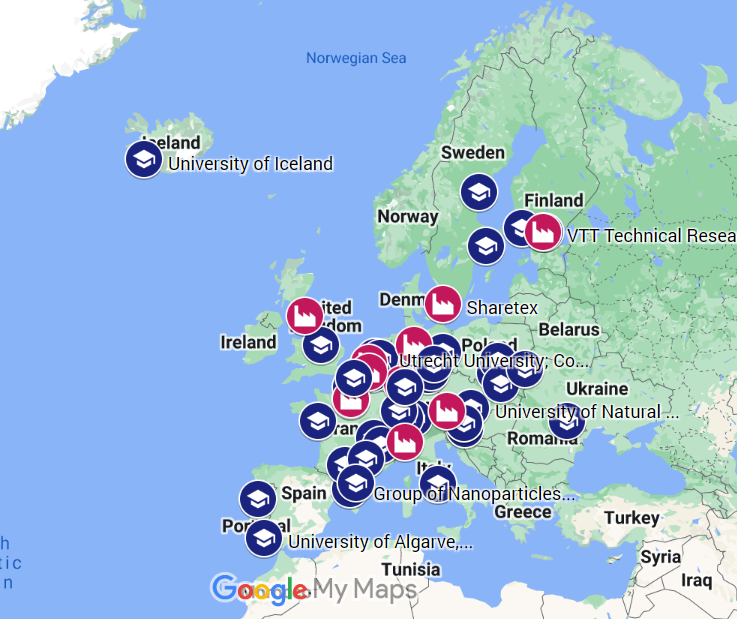
Industry
Academia & Research
Austria
Graz University of Technology
Institute of Chemistry and Technology of Biobased Systems – Ibiosys
Institute of Paper, Pulp and Fibre Technology
University of Graz
Institute of Chemistry Polysaccharides & Hydrocolloids (PS&HC)
University of Innsbruck
Research Institute of Textile Chemistry and Textile Physics (Dornbirn)
University of Natural Resources and Life Sciences (BOKU), Vienna
Institute of Chemistry of Renewable Resources, Vienna/Tulln
Belgium
KU Leuven
Bio- & Chemical Systems Technology,
Reactor Engineering and Safety (CREaS)
Soft Matter, Rheology and Technology (SMaRT)
Renewable Materials and Nanotechnology Research Group
Finland
Åbo Akademi University, Turku
Natural materials technology
VTT Technical Research Centre, Espoo
France
Armines – Mines Paristech
Centre for Material Forming (CEMEF),
Sophia Antipolis
Biobased polymers and composites team
Centre des Matériaux d’IMT MINES Alès (C2MA)
Advanced Polymer Materials (MPA)
Centre des recherches sur les macromolécules végétales
CERMAV
Grenoble
INP-LGP2-PAGORA
IMT Nord Europe CERI Materials and Processes
French National Institute for Agricultural Research (INRAE)
Laboratory of Agro-Industrial Chemistry, Toulouse
Biopolymers Interactions Assemblies (BIA) Research Unit, Nantes
Université de Picardie Jules Verne, Amiens
Laboratoire de Glycochimie, des Antimicrobiens et des Agroressources
Plant Biology and Innovation (BIOPI)
Enzyme and Cell Engineering Laboratory
Laboratoire Ingénierie des Matériaux Polymères, Lyon
UTA site Artois, Université d’Artois
Germany
Albert Ludwig University of Freiburg
Freiburg Materials Research Center
TU Darmstadt
Ernst-Berl-Institute for Technical and Macromolecular Chemistry
Fraunhofer Institute for Applied Polymer Research, Potsdam-Golm
Research Division Biopolymers
Friedrich Schiller University of Jena
Institute of Organic Chemistry and Macromolecular Chemistry
Center of Excellence of Polysaccharide Research
Thuringian Institute of Textile and Plastics Research Rudolstadt e.V (TITK) Thuringian Institute of Textile and Plastics Research Rudolstadt e.V
Italy
Universita’ degli Studi di Napoli Federico II – Dipartimento di Scienze Chimiche
Iceland
Netherlands
Utrecht University
Copernicus Institute of Sustainable Development Energy and Resources
Wageningen University and Research
Agrotechnology and Food Sciences
Poland
Jan Dlugosz University, Czestochowa
Faculty of Science and Technology
Łukasiewicz Research Network – Lodz Institute of Technology
Institute of Agrophysics, Polish Academy of Sciences
Portugal
University of Aveiro
CICECO – Aveiro Institute of Materials
QOPNA – Organic Chemistry, Natural Products and Foodstuffs
University of Algarve
MED—Mediterranean Institute for Agriculture, Environment and Development
Romania
“Petru Poni” Institute of Macromolecular Chemistry, Iasi
Slovenia
University of Maribor
Institute of Engineering Materials and Design
Laboratory for Characterization and Processing of Polymers (LCPP)
University of Ljubljana, Faculty of Mechanical Engineering
Laboratory of Hydraulic Machines (LVTS)
Spain
Institut de Ciència de Materials de Barcelona (ICMAB-CSIC) www.icmab.es Group of Nanoparticles and Nanocomposites (NN Group) nn.icmab.es
Universitat de Girona Laboratory of Sustainable Materials and Product Design (LEPAMAP-PRODIS)
Sweden
Chalmers University of Technology
Department of Chemistry and Chemical Engineering
KTH Royal Institute of Technology, Stockholm
Fibre and Polymer Technology
Mid-Sweden University, Sundsvall
Fibre Science and Communication Network
Switzerland
ETH Zürich
Laboratory of Food Biochemistry
United Kingdom
University of Nottingham
Food Sciences
EPNOE Partner Associations